Quotable
Books
Designing an iOS reading app for tracking books, capturing quotes, and turning private reading moments into thoughtful social experiences.
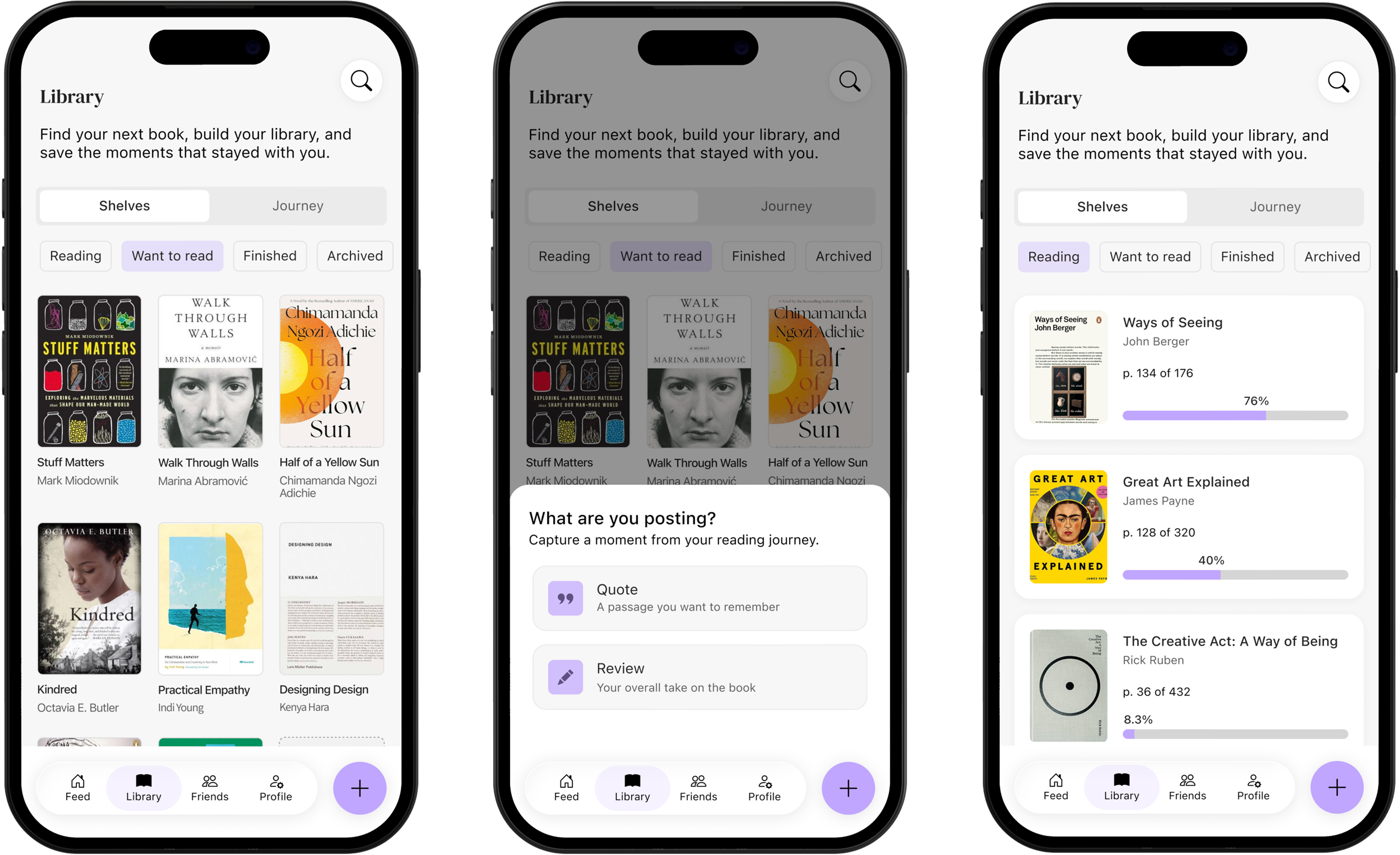
Reading is often described as solitary, but the parts of books that stay with us rarely stay private.
We underline, screenshot, share passages, and carry ideas into conversations long after we've read them. The social life of reading already exists, but it happens across scattered tools that were not designed for it.
Quotable Books is an iOS app for capturing quotes, sharing reflections, and tracking books. Currently in development and being tested in TestFlight, the product explores how private reading moments can become shared conversations without making the experience feel noisy. I joined the team to help shape the experience from the ground up, defining the product and brand, clarifying context, and designing core flows.
How do you design for something that happens in private, looks different for everyone, and leaves almost no trace?
Most reading apps organize reading around book states: want to read, reading, completed. Some add ratings, reviews, or social feeds. But they often miss the more immediate, emotional parts of reading: the sentence someone wants to remember, the thought they had mid-chapter, or the small moment that makes them want to talk to someone else.
Readers already capture these fragments in note apps, Kindle highlights, screenshots, and journals. But once saved, they are hard to organize, revisit, or connect back to the book they came from.
The challenge was to support both sides of reading: capturing something privately, and sharing what stayed with you. Quotable Books needed to make quotes and reflections easy to save in the moment, while creating a more thoughtful social layer around books.
What is the core action? Posting a quote is not the same as writing a review.
The first challenge was conceptual. Posting a quote needs to feel immediate and lightweight. But could it be designed without being intrusive?
We couldn't assume people stop mid-read every time something resonates. Maybe they highlight first and post later. Maybe they're reading digitally, and the behavior is completely different. There were more open questions than answers. So we did guerrilla research, interviewing people who matched our persona: serious readers, highlighters, note-takers. We wanted to understand their actual behaviors. What we learned shaped the posting flow directly: low friction, tied to the book, with the option to go deeper when the moment calls for it.
The posting flow form had a lot of optional fields: a quote, a note, an image, a new word, a page number, a spoiler toggle, a visibility setting. Shown all at once, the form would feel like a survey. So the structure should be progressive: only the essential inputs are visible by default, and everything else collapses until the user chooses to expand it. The result is a form that feels short when you need it to be, and deep when you want it to be. Someone posting a quick quote sees three fields.
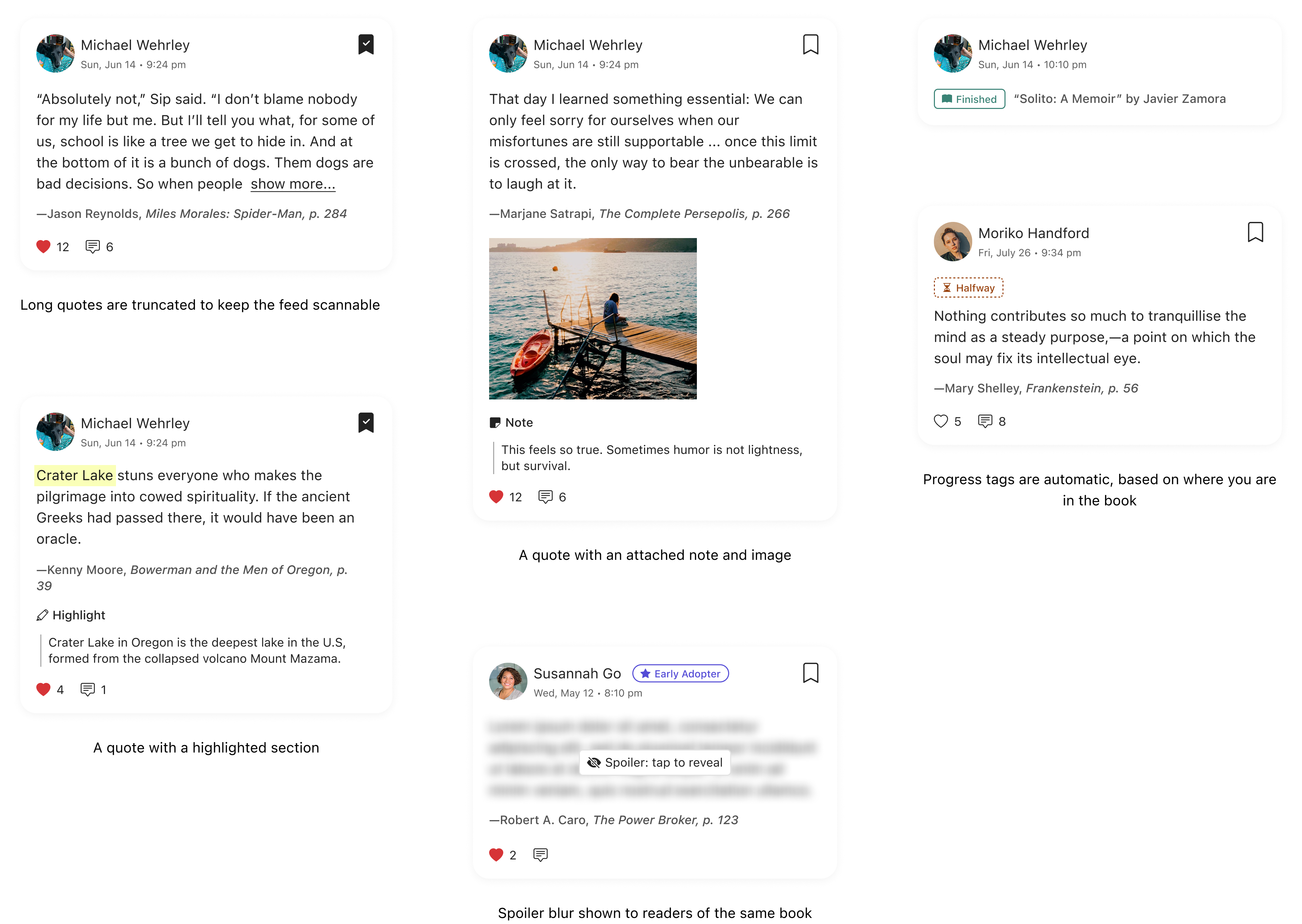
The feed needed to carry a lot of information such as content types like quotes and reviews, reading progress, visibility, spoiler states, without any of it competing for attention. Getting the visual hierarchy right across all those elements is still being refined through testing. The goal is a feed that feels like a conversation, not a content stream.
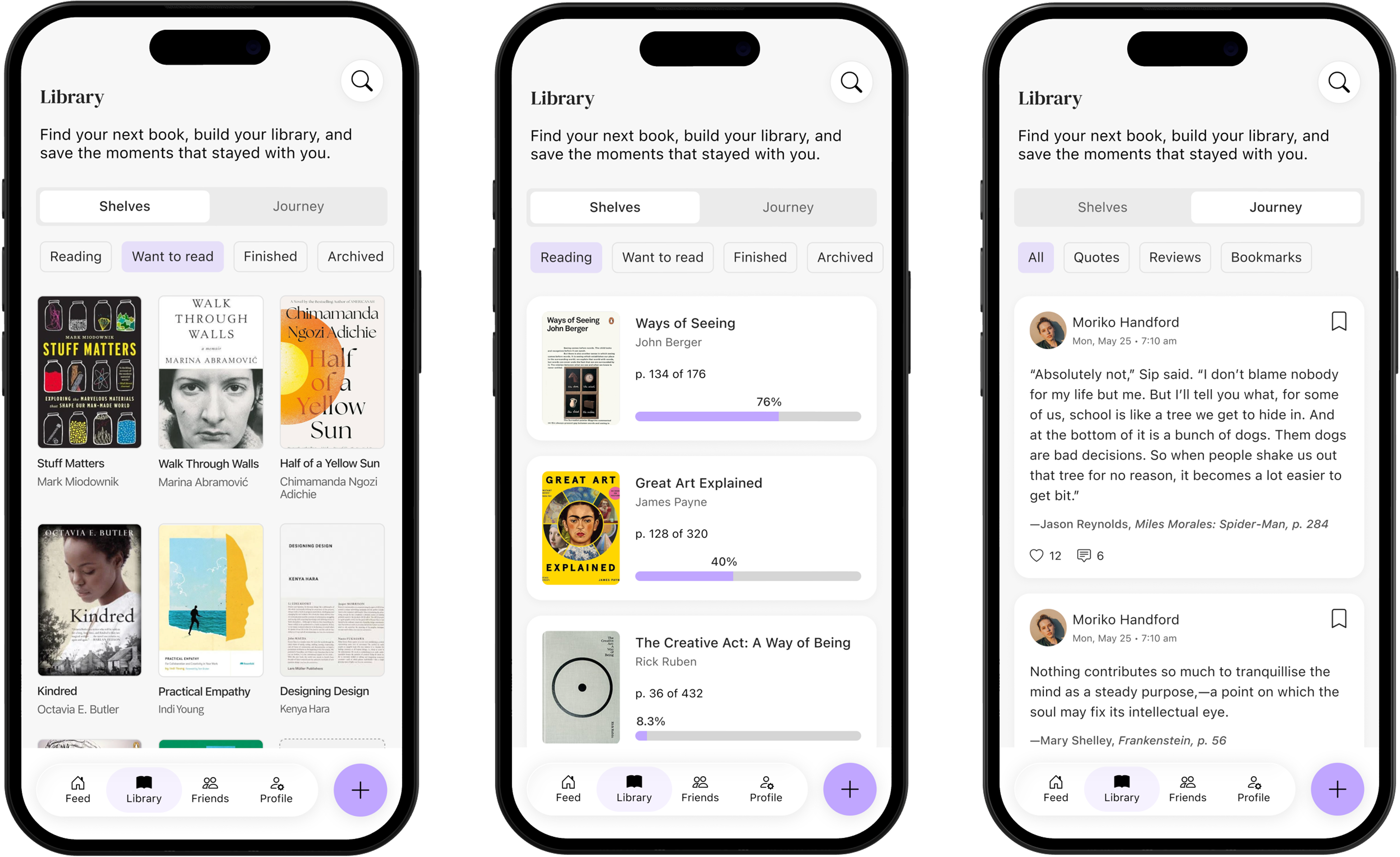
The library is organized around two distinct views: Shelves and Journey. Shelves is the collection. Books are organized by reading state: Reading, Want to Read, Finished, and Archived. It's the practical side of the library, where you manage what you're reading and track progress through each book.
Journey is the personal record, a chronological log of everything you've posted, filterable by type: Quotes, Reviews, and Bookmarks. It turns the library into something closer to a reading diary, where the books you've read are inseparable from the moments they left behind. The two views serve different needs without duplicating each other.
Currently in TestFlight testing with real users.
The core flows are functional and being validated through TestFlight. Early feedback confirms the thesis: people want a place where reading is sacred. What surprised us was how quickly it started to feel like a book club — shared quotes sparking conversations, friends following each other's reading in real time. This was the real goal of this app. We already have a handful of super users, which is the best early signal a product can get.
There are still a lot of open questions around functionality: voice entry, photo-to-text, and other capture methods that could make posting even more frictionless. These are being evaluated through real user feedback and will shape the roadmap.